
Many factors go into making someplace a good place to live and work. While traditional ways to measure place-based performance focus on economic growth, the Rural Livability Project assesses alternative factors that play important roles in defining how well people live in places. The project recently launched a new interactive map that visually presents county-based information across the United States representing three measures of livability: prosperity, quality of life and community assets. The map is housed on the project’s new website at https://www.rurallivability.org/prosperity/.
The goal of the Rural Livability Project is to understand and enhance the key factors that support thriving rural communities. The new map, in particular, was developed to help empower people to make data-informed choices about how to improve their communities.
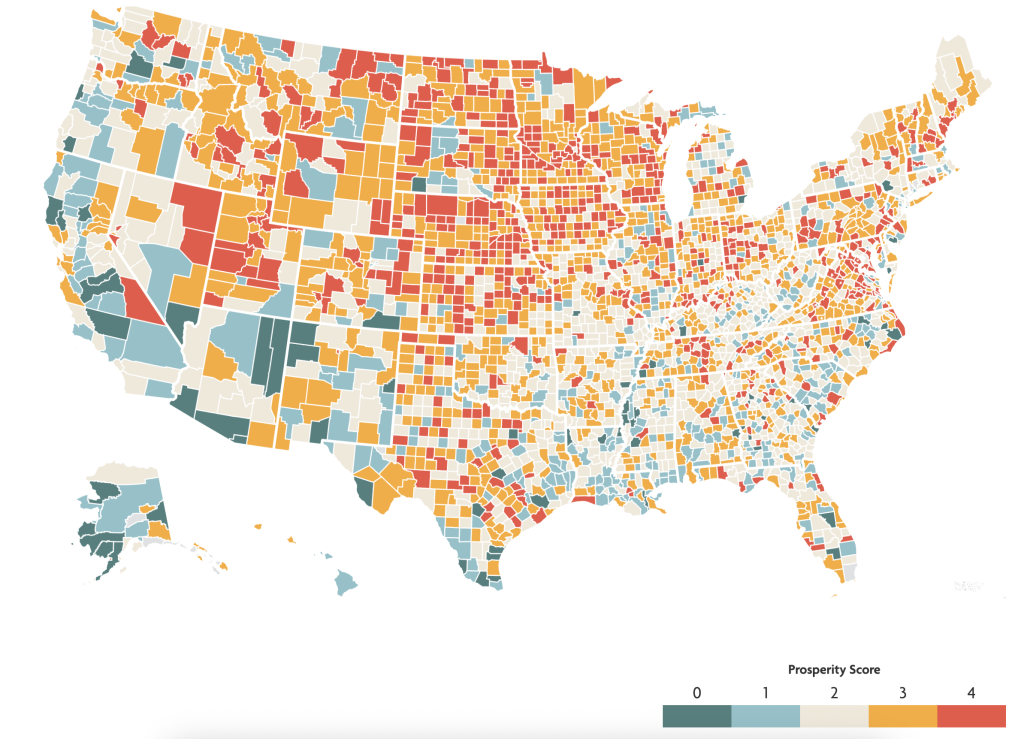
“Many communities, rather than narrowly focusing on jobs and population, want to think about ‘quality of life’ or ‘livability’ to understand how they’re doing, but it’s a difficult concept to measure,” says project leader Tessa Conroy, an associate professor and extension specialist in the Department of Agricultural and Applied Economics. “With this tool, communities have a way to measure success beyond a narrow focus on economic growth.”
Each measure on the map underscores different local strengths. The “prosperity” measure emphasizes affordability, stability and the capacity to meet everyday needs with indicators such as education and housing. The “quality of life” measure highlights amenities, magnetism and cultural experiences, which tend to attract people to a community. The “community assets” measure combines a mix of desirable characteristics from both the Prosperity and Quality of Life measures, in a way that better accounts for underappreciated rural assets.
“These three interactive maps tell very different stories about which places are doing well because they measure different aspects of a community,” explains Conroy. “We hope that putting these measures side by side will help people understand that there are different ways to think about improving quality of life, understand their assets and make informed choices for local investment.”
In addition to the new website, the Rural Livability Project team produces other products that address quality of life in rural areas. These include topic briefs, journal articles, infographics and webinars. The project, part of the Wisconsin Rural Partnerships Institute, continues to focus on evaluating and developing approaches to measure livability to better serve communities.
This work is supported by the USDA National Institute of Food and Agriculture. Any opinions, findings, conclusions, or recommendations expressed in this publication are those of the author(s) and should not be construed to represent any official USDA or U.S. Government determination or policy.